Rethinking Stakeholder Maps
Skip traditional stakeholder mapping templates that focus on generic corporate functions.
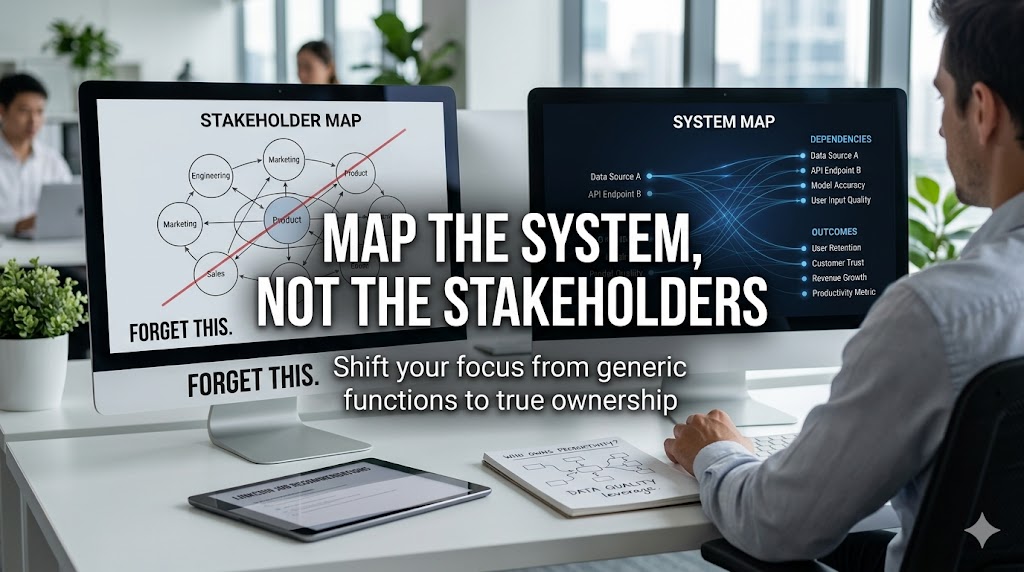
“Should I create a stakeholder map?”
A PM asked me this recently on a coaching call. My answer: Don’t.
Most people start with stakeholder mapping templates. Boxes, circles. Power vs influence grid. It looks structured, but it doesn’t help much.
Instead of starting with stakeholders, start with the system.
For the product area you own, ask two questions:
- What does it depend on?
- What does it drive?
Let’s take LinkedIn’s Job Recommendations feature.
A typical stakeholder map looks like this: Engineering, Data Science, Product, Recruiter Sales.
Now let’s look at the system.
What does it depend on?
- Completeness and accuracy of profiles
- Quality of job descriptions from recruiters
- How the model defines “relevance”
- Training from user actions (save, skip, apply, ignore)
- Balance between relevance and revenue from recruiters
What does it drive?
- Whether members trust LinkedIn for job discovery
- Whether profiles stay current or not
- Whether recruiters see enough quality applicants
- Whether the experience feels useful or noisy over time
Now the stakeholder map is not about functions. It’s about ownership.
- Who owns profile quality?
- Who defines relevance in the model?
- Who controls user behavior signals?
- Who owns recruiter outcomes?
- Who owns member trust when recommendations fail?
These are not Engineering questions, or Data Science questions. They are system questions.
If we start with a stakeholder map template, we get functions.
When we start with the system, we get outcomes, and where they fail, and who has the leverage.
What do you think? Share your thoughts on this post on LinkedIn.