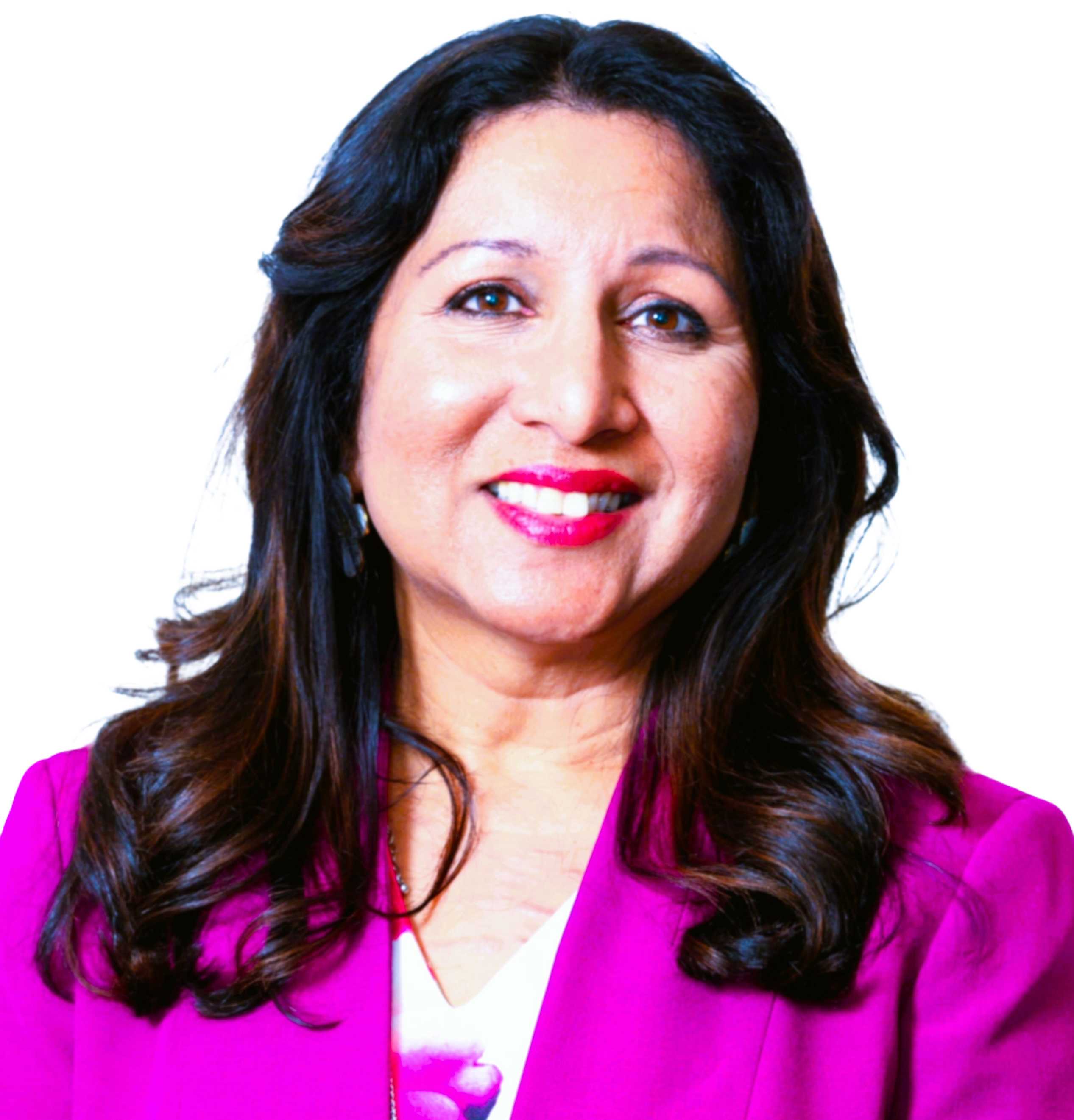
Jyotika Athavale
President, IEEE Computer Society
Jyotika Athavale is the President of the IEEE Computer Society and chairs the IEEE P2851 working group on functional safety and interoperability. She has built her engineering career at companies including Intel, NVIDIA, and Synopsys, with deep expertise in automotive functional safety and dependable autonomous systems. She is a principal engineer and a recognized leader in standards development and STEM advocacy.
· 31 min
Jyotika Athavale shares how technology standards get built for problems that don't yet exist, requiring a forward-looking lens that product leaders rarely apply to their own roadmaps. She breaks down how IEEE identifies emerging technologies through annual predictions reports, and how that feeds standardization, education, and certification roadmaps. Listeners will learn how to think about future problem discovery, how to engage in industry standards work to elevate their thought leadership, and how to navigate building a career and supporting women in STEM across decades.
Rahul Abhyankar [00:00] There are so many interesting topics to discuss with you, Jyotika, but one place I want to start is your expertise in automotive functional safety. In December of 2023, Tesla issued a recall to about 2 million vehicles that they've sold in the US, and that was driven by a federal regulator investigation that uncovered safety issues with their autopilot function. I don't know if we want to go into the specifics of Tesla, but when you think about automotive functional safety, how do you break down that system?
Jyotika Athavale [00:39] It's a great question. I won't comment on the Tesla topic, but it's kind of a vast space because there are a lot of areas that interact with functional safety, making all of the trade-offs with the increase in terms of performance targets, as well as the drive towards predictive maintenance, being able to predict failures before they occur in the field, which is really important for any safety-critical system, but more so for autonomous driving.
For functional safety in the context of automotive, there are governing standards such as ISO 26262, which describe all of the different activities that need to be considered during the safety engineering process. And then there are other standards as well. The one that I'm closest to is the one I currently chair, which is the IEEE P2851 on functional safety and interoperability, facilitating the data exchange across the application domains and looking at how we can seamlessly exchange that data using a unified set of methodologies and description languages and data models.
But then there's other standards as well. We're looking at now the dependability view of things. Functional safety can't be looked at in a silo or in isolation, but we really need to look at it more holistically in the context of reliability, availability, serviceability, real-time cybersecurity, so that we ensure that a system is dependable, that an autonomous system is dependable and the architecture is defined such that it meets the requirements of all of these technologies for a given use case.
Rahul Abhyankar [02:39] That's fascinating. The work that you are leading with the standards committees in IEEE and the work that happens in the industry—it feels like the velocity of that work on both those streams is very different. How long does it take for a standard to be set, to be achieved? And I'm sure that takes a lot of collaboration between industry, academia and so on. And then the pace of innovation in industry—so how do you balance those two things?
Jyotika Athavale [03:19] I don't know how many times I heard this question this week itself, so it's been coming up a lot and I think it's very important. For sure, standardization is kind of a slow process, and so typically three to five years is what I would think it would take for an average standard, at least in my experience, in IEEE and also the other standards I'm currently engaged with in other standards development organizations such as ISO.
When we start out with a problem statement, what is the problem that we are trying to solve with the standardization initiative? And of course we are bringing together many people, experts all across the industry, academia, maybe regulators, etc., and their time is all valuable. But we are really solving a future problem so that when the standard is published, it can be adopted and applied and will be still relevant in the industry at that time. So really looking out, forward-looking. Functional safety is still, from that standpoint, considered kind of an incubation technology. It is one which is not really at that level of maturity. So we are working on standardization very actively such that when it is in full deployment and mature, then all of these standards can be widely adopted and implemented by safety engineers across different industries.
Rahul Abhyankar [05:00] You mentioned that when you think about a problem in a particular domain, you don't just consider the problems that are in that domain today, but also what are the problems likely to be in the future. That aspect struck a chord with me because in my work in product management, and for many product managers, there is such an importance of understanding the problems that customers face, that users face, but a lot of our focus tends to be on the problems of today. And then we have a solution to address those problems and then over time we have the opportunity to define roadmaps and understand and uncover additional problems in the future. So when you start this problem discovery effort and you say you have to look at the future because the standards have to accommodate the longer timeline, what's the exercise that you go through to understand the problems of the future?
Jyotika Athavale [06:00] It's a very important question and I can give you an example of how we go about that in the IEEE Computer Society, because I'm kind of closest to that. We have a team or committee that is also tied to the IEEE Future Directions, that works on the Technology Predictions Report, and we do that every year. We published one this year, as well as in 2024, as to what are the key technologies that will mature this year in 2024, both from a market standpoint as well as the ones in IEEE.
We also look at it from the lens of impact to humanity. So those are the criteria we use. But regardless, just like IEEE, there are these organizations also within companies and across the industry that work on the technology trends and technology predictions, looking out there into the future and ranking these technologies which are the top ones.
Within IEEE, we publish that report, we have a megatrends report, and then that report is then used to define the roadmap of activities that we need to focus on within the Computer Society, including standardization. Do we need to form new standards committees to focus on some of these new technology areas that are emerging that we are not already covering? And then what are the other activities we need to do in conferences or publications or education, certification, skills development? So that basically feeds the roadmap for all of the activities, including standardization, identifying those gaps, making sure we are forming the committees and the study groups to drive the necessary powers for new working groups for new standards development topics.
Rahul Abhyankar [07:51] How did you get involved in IEEE? At what point in your career did that happen? Let's start there, and then I'll come to the next follow-up question, which is how do people get involved with IEEE?
Jyotika Athavale [08:05] Great question. I got involved first with IEEE as a student member when I was in college, doing my graduate school in Iowa, and I worked with my advisor there to publish my first paper in a journal. Once I started my career, I think most of my involvement was either through publications, doing more papers, or through technical committees, review committees for conferences, which were reviewing papers and mentoring papers. And of course conferences was also an integral part of that. It goes hand in hand.
But then when I switched also to functional safety, I got more involved in standardization just because standards committees are really important in functional safety in order to monitor the new requirements, the new methods, etc., that are being developed. So that's when I got closer to the standards activities. And later on I also applied for a position on the Board of Governors for the Computer Society because, other than the technical side of things, I also wanted to influence change in other areas related to STEM, such as D&I. I was active in that space in my work at Intel and wanted to make a bigger impact outside in the global community. So that's when I joined the Board of Governors and got more active in governance as well.
Rahul Abhyankar [09:52] It feels like you have had two parallel careers—one at Intel, growing through the ranks there in terms of the work that you did and becoming a principal engineer, and then a parallel career in IEEE going on at the same time, starting as a student contributor and then Board of Governors and now as the President of the IEEE Computer Society. So that's fascinating to have both those careers going on at the same time. How did you balance the aspect of your industry involvement and the thought leadership and the efforts that needed, and was there a crossover between that with respect to your work that you did in Intel and NVIDIA and so on?
Jyotika Athavale [10:41] I always feel like part of that is that intersection between your day job and how it is relevant in the work that you're doing in these organizations across the community. So that was part of it, but I think it was also bigger than that because it was just the passion to make a difference in the community, to influence and inspire the next generation of technologists and engineers, the young professional community.
To be honest, I think early on in my career I wasn't as active, and I think it was difficult as a parent trying to juggle my career with my family and my three children. As they started to grow, I had more time to contribute and to drive that passion forward.
Rahul Abhyankar [11:40] You started as a student contributor as part of your graduate education at Iowa. But for people who are working in software companies, technology companies, what's your advice for how they can elevate their own identity as a thought leader, and are there opportunities to participate in some of these standards efforts that IEEE has, or are there some criteria that need to be met for people to be able to do that?
Jyotika Athavale [12:19] It's a great question. IEEE invites participation in standardization across all of the different entities, including industry, academia, and government, and people can join at any phase of their career. It just depends on how the working group at the Standards Committee is defined. If it's an individual-based working group, then it's free for anyone to join and there's no bar. It's pretty much open for anyone to participate, either as a contributor, a voting member, or an observer. So anyone is free to join.
If it's an entity-based working group, then it's a little bit more restrictive because then the entity has to be a member, a paying member of the working group. So typically that's more difficult to do if your company is not a member or if you're in a university that's not a member. But there are many working groups in the standard space that will open participation for anyone to join. And I encourage even younger members to join, maybe initially as an observer, and to then increase their participation as they grow and are able to contribute in a more active way.
Rahul Abhyankar [13:48] When you look at the horizon of the future and what the innovations and the technology landscape is going to be, I'm reminded of this thing that Gartner has, which is they have this hype cycle of technologies, and that basically goes through the stages that technologies go through. There's initial excitement, then you have the disillusionment with that technology, and then there is a plateau of productivity where there is maturity and you can take advantage of those technologies. So how much do you give consideration to these types of principles of technology evolution as part of your work, not just within the standards, but also within your corporate career?
Jyotika Athavale [14:40] I'll talk about it both from an IEEE standpoint as well as from my day job standpoint. From an IEEE standpoint, I think that this is kind of factored in the technology predictions activity, as I was mentioning earlier, because we look at that year to year. So when we are defining which are the key or the top technologies that we want to focus our efforts on in a given year, we are going to consider that hype cycle, because we are looking at ranking the various technologies that we are seeing maturing within the span of that year, and that's what feeds the activities that we are going to focus on.
From my day job standpoint, a lot of it is, of course, business driven. So it's based on the customer need and the market requirements. That's where we focus our energies and efforts. But then also within the company—I work in an R&D group—we have our own organizations within the company that focus on the technology predictions as well. So it's a combination of using that data as well as the conversations that we have regularly with our customers on where to spend our energy and efforts.
Rahul Abhyankar [16:10] You got elected as the President of the IEEE Computer Society. This is a significant responsibility and a role. How did you come to the conclusion that you were ready to take on a role of this significance?
Jyotika Athavale [16:29] It's a good question. To be honest, I never really came to that conclusion because I didn't really apply for the position, and it kind of happened on accident because I was nominated for it even though I didn't apply for it. When I was nominated, I was second-guessing myself as to whether or not I was ready for it, because when they asked me whether I accept the nomination, I didn't think that I was ready for it. I didn't know what it entailed and what I would need to take on. I think most of us are like that. We're critical of ourselves and we never think we're ready for something when indeed we may be.
I was encouraged by my mentors and friends and colleagues that I spoke to to go ahead with it, and so I decided to proceed and then see how I could contribute from there on. When I did get elected, of course I was very excited, wanted to make an impact, and I'm really grateful for all of the support that came in from all of the board and the community within the Computer Society as well as outside in my day job to help support me in this role, and without that I wouldn't be able to do it. So I'm really grateful for that. My family especially, who supports that each day.
Rahul Abhyankar [18:11] Based on your journey, what do you see as the future opportunities for women in engineering, and how do you advise women in engineering to take advantage of those opportunities?
Jyotika Athavale [18:29] That's kind of a loaded question. I'm really passionate about inspiring women in STEM. The numbers speak for themselves and women really are underrepresented very much so today. I think that there's a lot that all of us can do to help change that, to drive that change in the community.
In IEEE we have an organization, the Women in Engineering organization, that does a lot of work to help inspire and encourage women in STEM careers. But then also within each society, we have D&I committees that are doing a lot of work. Within the Computer Society there's a D&I committee. We have a D&I fund. With the IEEE Foundation we drive a grant program each year. We award grants and scholarships and engage in other activities to encourage women in STEM.
I really think this is really the time when women can be empowered and can bridge that gap that we are seeing today in the industry. I think the sky is the limit. All of our women engineers have unlimited potential to achieve their goals. But I think also we need to really look at this at the grassroots level and see how we can encourage more women in STEM careers, starting in middle school, in high school.
Having gone through that journey myself, I have a daughter who's now working in the computer science field, and also being in a family of women, my mom was a very strong role model for us. I think that making those choices early, influencing those choices, helping provide that support system and encouragement at those early years, but then it doesn't really end there.
Women see a lot of challenges as they start their families, to be able to balance that with their day job and build a career, so really having that support system all through that period. I've seen a lot of my colleagues, engineers that I went to school with, leave the field sadly later on in their careers because it was very difficult to balance with their family obligations and commitments. So I think that there's a lot that we can do to support women all through their careers.
And it becomes more and more lonely, I think, as you get to the higher levels because there's just very few women up there, and then it becomes more and more difficult for them as well to cope with the demands and to be able to influence and to be able to drive change at that higher level. So there's definitely work to do, but I know that we can get there, and I'm thankful and grateful that there are a lot of people who are supporting that and working together to make it happen.
Rahul Abhyankar [22:05] Who are the leaders that you've been inspired by?
Jyotika Athavale [22:09] There have been many. Growing up, I was inspired by JK Rowling. I think that she's a great writer. And I was also inspired a lot by my father. He always gave me good advice and was a great role model for me in many ways. But then I've had several role models through my journey in my career, at work, in my companies, so I continue to get inspired day to day.
Rahul Abhyankar [22:54] As you look across the landscape of technology and innovation, obviously AI is the rage nowadays. How do you see AI and the evolution of AI, especially in your role as the President of the IEEE Computer Society?
Jyotika Athavale [23:14] There is a lot of activity today happening and, of course, the advancements are happening at a very rapid pace. A lot of initiatives are being driven within companies, within the IEEE as well, to keep up with that pace of innovation. Across all of our program boards, including standardization, including conferences and publications, our certification programs, our chapter activities, we are driving different topics with respect to AI. But then also working closely with the government in terms of the regulations and the regulatory aspects, to also consider the social aspects and social implications of AI, which is very important to us today.
Our technology predictions activities, as I mentioned earlier, we had, of course, Gen AI at the top of the list, which is no surprise. So there's a lot happening and a lot more work to be done, but it's pretty much touching every society today within the IEEE umbrella, including the Computer Society but not limited to that. Every other society is also including AI in its scope, just because it is touching all of the different application domains and all of the different technologies—kind of that backbone technology that is touching every application area.
We are also working very closely with government activities. I mentioned NIST in the standardization space, and then also collaborating with other SDOs on non-standards topics related to AI and safe AI.
Rahul Abhyankar [25:15] As you mentor young women into STEM, what are the questions that you're most often asked, and what advice do you find yourself giving most often?
Jyotika Athavale [25:32] A lot of the questions I get asked are from the engineers that I've been mentoring—how they can further their career, what else they can do to build their technical skills, their soft skills. How can they widen their scope, make impact outside of their day-to-day activity, and how can they grow?
Sometimes it's around certain resistance that they may see at work within their groups, or having to deal with those challenges with respect to interactions at work. Sometimes it's just around balancing the day jobs with their obligations at home. So I think it's very different topics. Sometimes it's just around, well, how do I get involved in activities outside, as we talked about with IEEE or standards, how can I join? It's just that awareness of how to get involved.
Rahul Abhyankar [26:51] What's the advice that you find yourself repeating almost to a fault?
Jyotika Athavale [27:01] The advice that I find myself repeating is never give up. There will be a lot of people that will tell you that certain things are not possible, or there's no way to do that. But you always find it in yourself to find a way if you have the passion to do it. So never give up. Keep on trying. Failure is the stepping stone to success. Just let your passion guide you, and you will find a way to make your dreams come true. Just keep on at it.
Rahul Abhyankar [27:38] Beautiful. I think that's a great note to conclude our conversation on. It's been fantastic, Jyotika, and as someone who's balanced two careers, one on the corporate side and having tremendous growth there through Intel, NVIDIA and now at Synopsys, and also in the standards and the industry, I wish you all the best in your role as the President of the IEEE Computer Society. The work that you are driving across the standards bodies, I think that's going to be significant in shaping the future of a lot of technologies across the industry and also through the regulatory and the policy landscape.
Jyotika Athavale [28:24] Thank you very much, Rahul. I really appreciate it. Thanks for this opportunity to have this conversation with you. I really enjoyed it and I look forward to staying in touch and we'll talk again soon.
Rahul Abhyankar [28:38] Sounds good. Thanks, Jyotika.